

Ask how much you need to retire comfortably in London and most people reach for a big number. London is expensive, so a London retirement must be too.
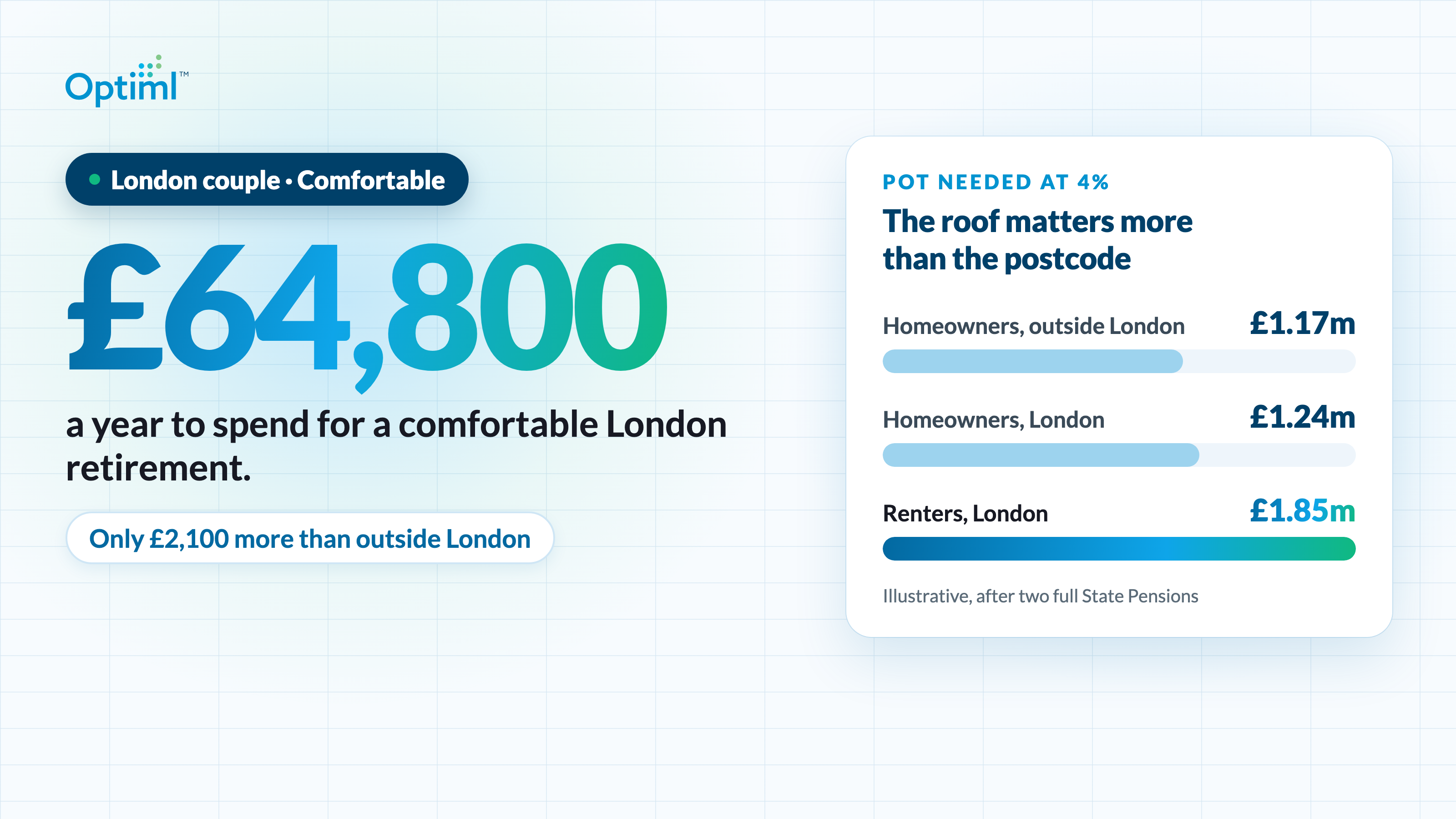
But by the UK's best-known retirement yardstick, the capital barely moves the needle. A couple needs about £64,800 a year to spend for a comfortable retirement in London. Outside London, it's £62,700. The difference is £2,100 a year, about 3%.
What most people miss is the assumption under both figures: that you own your home outright. In London, that one assumption matters far more than anything on the weekly shopping list.
And there's a second step most headlines skip. £64,800 is spending money, after tax. To know how much pension a couple actually needs, you have to gross it up, count two State Pensions and two Personal Allowances, then work out the pot that fills the gap.
The London numbers, by the Pensions UK yardstick
The figures come from the Retirement Living Standards, published by Pensions UK (formerly the PLSA) and researched by Loughborough University's Centre for Research in Social Policy. The latest edition, the 2025 update, was published in June 2026.
We've walked through the three standards before, so briefly: Minimum, Moderate and Comfortable are three costed levels of retirement lifestyle. They're standards, not averages. They describe what a lifestyle costs, not what London couples actually spend.
Source: Pensions UK, Retirement Living Standards in the UK: 2025 update (June 2026). Annual spending for two people, after tax, excluding rent and mortgage payments.
Read the last column again. At every level, London adds between £1,600 and £2,100 a year. The published figures don't break that premium down by category, so we won't guess at what drives it. What matters is its size: small.
For a feel of what Comfortable covers, the UK-wide breakdown (not a London one) puts the largest single line on social and cultural participation, at £373.78 a week for a couple. Food comes next, at £284.60 a week. It's a budget where seeing people and doing things costs more than the weekly shop.
London also has a perk worth knowing about. From State Pension age, if your main home is in a London borough or the City of London, you become eligible for the older person's Freedom Pass, with free travel on London buses, the Tube, trams, the DLR, the Overground and most National Rail services within London. Londoners aged 60 and over who aren't yet eligible can apply for a 60+ London Oyster photocard for free travel on the same services.
The assumption that matters most in London: owning your home
Here's the line in the methodology that changes everything. The Retirement Living Standards include household bills and basic maintenance, but not rent or mortgage payments. At Moderate and Comfortable, the research groups agreed it's reasonable to assume people enter retirement "mortgage or rent free". Social care, dependants and pets aren't included either.
For a couple who've cleared the mortgage, that holds. But plenty of Londoners reach retirement as renters, and for them the yardstick leaves out the biggest bill.
The Pensions UK report points to new research on minimum living standards in the capital, Trust for London's Minimum Income Standard for London 2025. For the first time, London groups agreed that a retired household's minimum budget should include private rent, because social housing is so hard to access in the capital.
The effect is large. At the Minimum standard, a London couple's required spending goes from £24,073 a year with no rent to £43,711 with a private rent. That's an extra £19,638 a year at the most basic level. These figures are for Minimum only, and the report describes the rental values as indicative, averaged across Inner and Outer London.
What London rents look like
Private rents vary a long way across the capital. ONS figures released in April 2026 put the average two-bedroom rent at, for example:
- Bromley: £1,627 a month (£19,524 a year)
- Croydon: £1,551 a month
- Barnet: £1,837 a month
- Camden: £2,465 a month
- Kensington and Chelsea: £3,341 a month
The published figures come with a caution that local samples shouldn't be compared precisely between areas, so read them as examples, not a ranking. Across all property sizes, the London average was £2,332 a month in August 2026, a provisional figure.
None of this makes renting in retirement a failure of planning. It's a different plan with a different number, and it deserves to be costed properly rather than assumed away.
From spending to income: the gross-up
£64,800 is what a couple spends after tax. Pension income is taxed as it's paid out, so the next step is working backwards to the income needed before tax.
Londoners pay income tax at England's rates (rates differ in Scotland). For 2026/27, three things work in a couple's favour:
- Two Personal Allowances. Each of you can receive £12,570 tax-free, and the allowance is frozen until April 2031.
- A wide basic-rate band. Income above the allowance is taxed at 20%, up to £50,270 each.
- No National Insurance on pension income, State Pension included.
Split the spending evenly and each of you needs £32,400 after tax. That takes about £37,358 of gross income each: the first £12,570 tax-free, the remaining £24,788 taxed at 20%, for about £4,958 of tax. As a couple, that's about £74,715 of gross income and £9,915 of tax.
An even split isn't automatic. It depends on whose name each pension or savings pot is in, a question we've unpacked before.
Now count the State Pension. The full new State Pension is £241.30 a week in 2026/27, about £12,548 a year each, or £25,095 for the two of you. It needs 35 qualifying years of National Insurance, and not everyone gets the full amount. Each State Pension uses up almost all of each Personal Allowance, so nearly every pound drawn on top is taxed at 20%.
Take the two State Pensions away from £74,715 and the gap your own savings must fill is about £49,620 a year, before tax.
That translation, from a spending target to gross income to the gap your own pots have to cover, is the first job Optiml UK is being built to do, on your real numbers rather than a standard household's.
A worked example: Nadia and Jonathan
Consider Nadia and Jonathan, both 67, in London. They own their home outright, both receive the full new State Pension, and they're aiming for the Comfortable standard. (State Pension age is currently rising from 66 to 67 between 2026 and 2028; they're already past it.)
These are illustrative sums in today's money, on England's 2026/27 tax rates. They show the shape of the problem, not a forecast of what any particular couple needs.
Turning the gap into a pot
To turn a yearly gap into a pot, divide it by a withdrawal rate. The rate is an assumption, not a recommendation, and none is guaranteed to hold: investments can fall as well as rise, and drawdown and sequence risk each have their own post. For scale, Nadia and Jonathan's £49,620 gap implies a pot of roughly:
- £992,000 at a 5% withdrawal rate
- £1.24m at 4%
- £1.42m at 3.5%
Move the same couple outside London and Comfortable drops to £62,700. They'd need about £72,090 of gross income, a gap of about £46,995, and roughly £1.17m at 4%. So London adds about £2,600 a year of gross income and around £66,000 of pot. Real money, but not the headline.
The version where they rent
Same couple, same Comfortable lifestyle, but renting a two-bedroom home in Bromley at £1,627 a month, or £19,524 a year. Their spending need rises to £84,324, or £42,162 each. Each needs about £49,560 of gross income, still just under the £50,270 higher-rate threshold. As a couple, that's about £99,120 gross, a gap of about £74,025 a year, and roughly £1.85m at 4%.
Assumptions: England 2026/27 tax rates, today's money, an even income split, two full new State Pensions, and the whole gap drawn as taxable pension income. Pot = gap ÷ 4%.
Renting adds about £24,400 a year of gross income and roughly £610,000 of pot at 4%. The everyday London premium is worth about £66,000 of pot. Rent adds more than nine times as much.
What these sums leave out
- All of the gap is assumed to come from taxable pension income. Taking part as tax-free cash, or drawing from ISAs (Individual Savings Accounts), would lower the gross figure. Withdrawal order is a topic of its own.
- No investment growth or inflation path is modelled.
- Rent is held flat in today's money, which is a simplification.
- No care costs.
What a yardstick can't tell you
A standard is a starting point, not a plan. It can't know whose name your pensions are in, when each State Pension starts, whether you'll take tax-free cash, or whether your housing cost is nothing, the tail of a mortgage or a monthly rent.
That's exactly the gap Optiml UK is designed to close. Built by the team behind Optiml's Canadian platform, around UK pensions, ISAs, the State Pension and HMRC rules, it will start from what you actually plan to spend and model the income, tax and pot behind it. Compare Plans is designed to set scenarios side by side, owning versus renting, London versus moving out, so the trade-off shows up in pounds. The Success Score will stress-test the result against up to 50 market scenarios, because a pot that works on average isn't always one that holds up through a rough decade.
The real London number
So, how much do you need to retire comfortably in London? On these illustrative sums, a couple who own their home need about £64,800 a year to spend, roughly £74,700 of gross income, and a pot in the region of £1.24m at a 4% withdrawal assumption, alongside two full State Pensions. A couple who rent can need a pot hundreds of thousands of pounds larger for the same lifestyle.
The capital's everyday premium is real, but small. Housing is the big variable, and it's the one worth pinning down first.
Optiml is coming to the UK to model your own version of these numbers.
It's not about the postcode. It's about the roof.