

"Can we stop now, or should we do one more year?"
It's one of the most common questions couples ask in the last stretch before retirement. And one more year usually feels like the safe answer. Another year of salary, another year of contributions, another year for the pot to grow.
But a single extra year is worth less than it feels, and in more specific ways. Some of what people count as a gain happens anyway. Some of it is taxed harder than the income it replaces. And the real cost, a year of your life at 60, never shows up in a spreadsheet.
So let's isolate it. One couple, one extra year, run both ways.
What one more year actually moves
Working to 61 instead of 60 pulls five levers at once:
- One more year of salary. That year's spending comes from pay, so nothing needs to come out of your pensions.
- One more year of pension contributions. Your own, the tax relief on them, and your employer's.
- One more year of growth on money you haven't touched.
- One fewer year of drawdown to fund.
- A shorter bridge to State Pension age. Six years living off your own savings instead of seven.
Listed like that, it sounds like five separate wins. In the maths, they overlap. The last three are really one lever seen from different angles. It's a year of drawdown that never happens, plus the growth on the money that stays invested because of it.
That matters, because counting one gain three times is exactly how "one more year" starts to feel bigger than it is. Untangling overlaps like these, on your own numbers, is a big part of what Optiml UK is being built to do.
If you're weighing a much earlier exit, the full bridge to State Pension age has its own post. This one stays on the single year.
Meet Martin and Claire
Martin and Claire are both 60 in the 2026/27 tax year and live in England. Both were born in 1966, so their State Pension age is 67.
They have £650,000 between them in defined contribution pensions and a paid-off home. Each already has at least 35 qualifying years of National Insurance (NI), so a full new State Pension of £12,548 a year is coming either way.
The numbers below are my own simplified maths, with round figures and every assumption on the table so you can check each step. Optiml UK is still being built, so treat this as a worked sketch of the decision it's designed to model on your real numbers.
Income Tax rates differ in Scotland. And 4% growth is an assumption, not a promise. Investments can fall as well as rise, and a weak year early on would move every figure below.
Retire at 60 vs retire at 61
Retire at 60
To spend £45,000 after tax, Martin and Claire draw about £47,000 a year from their pensions, split equally. With 25% of each withdrawal tax-free and each partner's £12,570 Personal Allowance covering most of the rest, the tax bill is only about £2,000 a year.
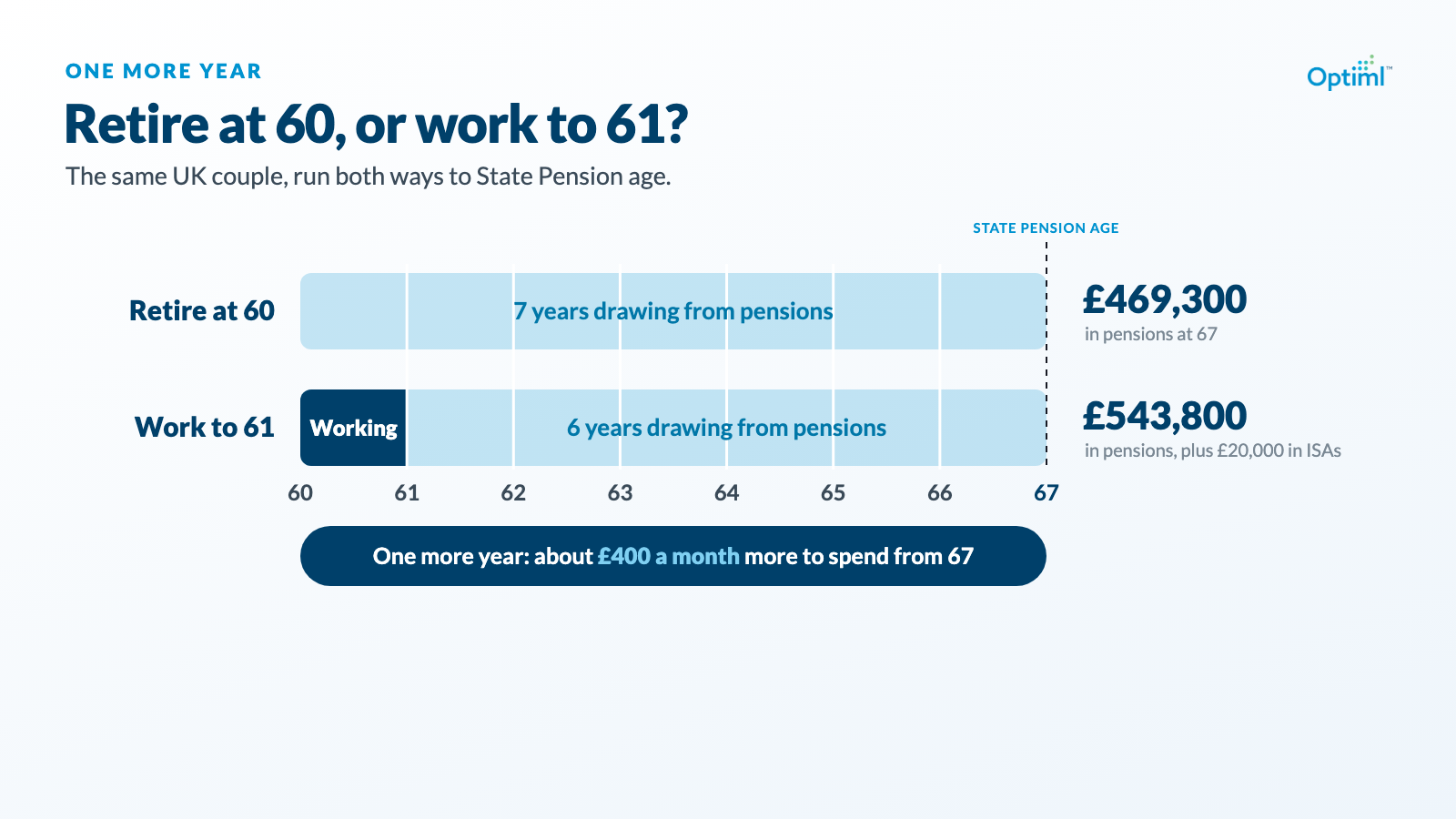
They do that for seven years, from 60 to 66. When both State Pensions start at 67, their pots are projected at about £469,300.
Retire at 61
At 60, their salaries pay for everything. After Income Tax, NI and their own pension contributions, take-home is about £60,800. They spend £45,000 and put the remaining £15,800 into ISAs (Individual Savings Accounts).
Meanwhile, £9,600 goes into their pensions and nothing comes out. From 61 they draw the same £47,000 a year, for six years instead of seven. At 67, their pots are projected at about £543,800, with roughly £20,000 more in ISAs.
So one more year leaves them about £94,500 better off at State Pension age. That's real money. But it's worth looking at where it comes from.
Where the £74,500 pension gap comes from
- About £62,000 is the £47,000 they didn't withdraw at 60, plus seven years of growth.
- About £12,500 is the £9,600 of contributions, plus the same growth.
Notice what isn't on that list. It sounds like one more year means a year of growth on £650,000, which at 4% would be £26,000. But the pot grows whether they're working or not. The only extra growth is on money that stayed in or newly went in, about £2,300 in that first year.
The honest other side
The salary is taxed harder than the drawdown it replaces
In the working year, Martin and Claire earn £80,000 and pay about £15,400 in Income Tax and NI. That's roughly 19%. National Insurance doesn't stop at 60. It stops at State Pension age, so the extra year's salary still carries it.
Funding the same year from drawdown would have cost about £2,000 in tax. Roughly 4%.
Across 60 to 66, the one-more-year version pays nearly twice as much tax and NI, about £27,500 against £14,000, and still comes out ahead. Just by less than the salary suggests.
Compared with retiring at 60, an £80,000 year leaves them about £72,400 better off at 60:
- £47,000 left in their pensions
- £9,600 of new contributions
- £15,800 saved into ISAs
And most of that sits in pensions, which are taxed when drawn. After 67, each £12,548 State Pension fills almost all of a £12,570 Personal Allowance, so roughly 15p of every extra £1 they draw goes in tax.
What it buys, in spending terms
Spread the extra £94,500 evenly from 67 to 95, at the same 4% growth, and after tax it's worth about £4,800 a year. Roughly £400 a month, for 28 years.
That's the honest price tag. One year of full-time work at 60 buys about £400 a month from 67 onwards.
The year you give up
What the spreadsheet can't show is the other side of the trade. The year Martin and Claire give up is a year at 60, not at 85. For most people, the early 60s are some of the most active years of retirement, the years for travel, long walks and time with family.
And on these assumptions, both versions of their plan fund £45,000 a year to age 95. The extra year doesn't decide whether their retirement works. It decides how much room there is.
When one more year is worth it, and when it isn't
The same year can be decisive for one couple and a nice-to-have for another. It tends to earn its keep when:
- Your plan only works with it. If the spending you want is covered at 61 but not at 60, the year is closing a real gap, not adding margin.
- You're short of 35 qualifying NI years. An extra year of work can add a qualifying year, worth about 1/35 of the full State Pension, roughly £358 a year.
- The contribution lever is big. An employer paying well above the minimum, or higher-rate relief at 40% on contributions that may later be drawn at 20%, makes the year work harder. Everything still has to fit within the £60,000 Annual Allowance.
- You like the work. A year you'd enjoy anyway costs far less than a year you're enduring.
It's harder to justify when:
- Your plan already funds the retirement you want, with room to spare, like Martin and Claire's. The year mostly buys a bigger cushion later.
- The cost sits outside the numbers. Your health, a partner who's already stopped, or plans that simply work better at 60 than at 61.
There's also a middle path, part-time work alongside a smaller drawdown, which has its own post and its own maths.
This is the comparison Optiml UK is being built to make on your own numbers. When it launches, Compare Plans is designed to put a retire-at-60 plan and a retire-at-61 plan side by side, with withdrawals sequenced for tax and each version stress-tested across market scenarios rather than one flat growth rate. And it's designed to answer in the terms that matter most, which is how much each version lets you spend, every year.
Decide it on purpose
One more year isn't a good decision or a bad one. For Martin and Claire, it's worth about £400 a month from 67, paid for with a year of freedom at 60. Some couples would take that trade without blinking. Others wouldn't. Both are right, as long as they've seen the number before they choose.
Optiml is coming to the UK, and it's being built to show you that number on your own pensions, salaries and State Pension age before you hand in your notice.